Pathway to the Beyond
Werner Huemer
Today in the field of research into death there is agreement that every dying person experiences certain stages in a similar form. Within the scope of this series, we have reported on typical “near-death experiences”. The interpretation of such near-death experiences is controversial, but studies such as those of the Dutch cardiologist Dr. Pim van Lommel (interview in part 3 of this series: GrailWorld 14) suggest that human consciousness exists beyond the body. Thus we live on after death. But where and how? The concluding part of the series “I have experienced death” summarises the stages of death and leads a little part of the way into the world hereafter.
Breathing heavily, he lay on the deathbed. His physical distress approached a climax, his thoughts drew picture after picture, but with increasingly slow, weak strokes. Whatever moved him inwardly in this sleep-like reverie could no longer be seen. There was no smile left on his features, no tears either. Actually, the exhausted body was hardly still connected to life.
Did he not sense his wife’s love, her tangible closeness, her perceptible desire to restrain him from this last volition to let go? When she left the room briefly, and as her warmth seemed somewhat more distant, he gave way.
For him it was now as if glowing life suddenly flowed through him. A rushing journey through his own earthly existence began: all the high and low points of his past experience came powerfully into his consciousness. Everything which had ever made an impression upon his soul in the course of the many years was now there all at once – perceptive to all his senses, present in all its vividness. At the same time, it was also clear, without doubt and with no self-deception, what was good amongst all that and what was not.
In the next moment – it could not have been more than a short moment – he heard the ward doctor declare him dead. At the same time, it was as if he was being powerfully pulled through a dark tunnel. He heard only a deep, piercing hum until suddenly he could once again recognise the familiar surroundings: the hospital room where he spent the last days, the doctor, his grieving wife by the bedside and a few relatives, who stood to one side. But then his gaze fell … on his own body! Yes, what he saw before him, not as if in a mirror, but for the first time in three-dimensional space, this was … he himself!
He had never seriously considered the possibility of a life after death. So for the time being, it only became clear to him as an overwhelming experience that he was outside the body that was hitherto his – and nevertheless he still had a body. He called out to his wife, loud and clearly – but she did not hear him. He shouted to those standing around, but they showed no reaction, whilst he himself could perceive all those present in a peculiar overall review. It seemed to him as though he knew their thoughts, even before they uttered them …
At the threshold of death
Review of life, tunnel adventure, out-of-body experience, widened perception: these experiences on the verge of death are repeatedly documented by death research, and there can hardly still be any doubt that every person actually lives through these stations at the end of life. But how do things go on after that? What do we go through and experience in the world beyond?
As uniformly as most near-death descriptions appear in the essential points, so do the accounts which seek to portray subsequent life in the world beyond, some of which are received through a medium, differ a lot from each other. On the one hand, the accounts speak of an indescribable experience of light and love, but partly also of very unpleasant experiences, which result from the realisation of culpable conduct or are interpreted as “experiences of hell”.
With this is mind, is it possible at all to receive an objective picture of life in the hereafter if we have such different descriptions and even more varied interpretations before us?
First steps on the other side
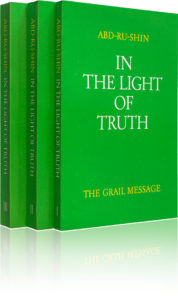
In his work “In the Light of Truth – The Grail Message”, Abd-ru-shin shows clearly that with the first steps a person takes on the other side after death, he is still connected with the physical world – and in fact this will be longer and more intensive, the stronger he clung to the material while he lived on earth. The near-death experience can result in an awakening, which is accompanied by uncertainty and from time to time also bitter realisations of Truth. As an example, Abd-ru-shin describes the awakening of a person who did not believe in a continuation of life after death and now witnesses, from the other side, the funeral of his physical body:
“The sound of a voice he used to know gradually awakens him again. He sees the body he used on earth surrounded by flowers. He would like to fly away, but he finds it impossible to sever himself from this cold, lifeless body. He distinctly feels he is still connected to it. Again he hears the voice which awoke him from his slumber. It is his friend speaking to another person. They have each brought a wreath and are talking together while laying them down. No one else is in the room.
His friend! He wishes to attract his attention, also that of the other man; they were often welcome guests together in his home. He must tell them that strange as it may seem he is still alive, that he can still hear what they are saying! He calls out! But his friend calmly turns to his companion and goes on talking. But what he says gives him a shock! Is that his friend? Is that the way he talks about him now?
Petrified, he listens to the words of these people with whom he had so often drunk and laughed, and who only flattered him while sitting at his table enjoying the hospitality of his home!
They left and others came. How clearly he could now see through people! So many whom he had highly valued now filled him with disgust and anger, and several whom he had always disregarded he would like to shake hands with gratefully. But they neither heard nor sensed him, although he shrieked and raved at them to prove he was still alive!
In a great procession the body was carried to the grave. He sat astride the coffin! Embittered and desperate, he could now but laugh and laugh! But his laughter quickly gave way to deepest despondency, and a great feeling of desolation assailed him. He became tired and fell asleep.“1
In the transition at the threshold of death, our consciousness is still bound to a certain degree to the condition of the physical body. From a higher “vantage point”, we experience scenes from the physical world in which we can no longer intervene however. In essence, we may feel abandoned, and life requiring us now to stride along new paths …
However, we are never really left alone, because everywhere in Creation security can always be experienced – as long as our own inner orientation does not prevent it. Thus in accounts of near-death experiences the dying person often speaks of being bathed in a “warm light”, which he describes as “living love”. Personal relationships with deceased relatives can evidently also manifest as apparent support in this phase of transition, for example, by being available as helpers in the birth into the other world.
Incidentally, a remarkable detail shows up in these perceptions: the former relatives, who are now present, are recognised in person, but they are not identified from an impression of certain physical appearances known from the physical world. The great-grandmother therefore meets her grandchild not in the stooped, wrinkled condition of her last years on earth, but in her present soul garb, in appearance recognisably characterised by the individuality of her personality.
In present-day books or seminars about dying and near-death experiences, such experiences of light and love tend to be placed very conspicuously in the foreground, with the overall view emerging more or less that, after having passed on, each person experiences only security, that he continues to live within the circle of his kinsfolk and possibly some luminous figures, wisely looking at the physical world from above, so to speak. This “bright picture” is underpinned by death research and is no doubt helpful when it comes to, for example, counteracting exaggerated fears of death or in offering needed comfort in bereavement. But we must be clear that only a small partial aspect of reality, a tiny segment, is shown.
Neither should we believe that the sum of all descriptions about near-death experiences can convey a real glimpse of life on the other side. That would be a fallacy, because everything that could ever be recorded in death research always refers only to that span of time in which a certain connection between soul and body still exists. In this phase impressions close to the body mix with psychic otherworldly experiences in a “rollercoaster of emotions”.
Final release from the body
What happens to us when the connection to the body is finally released? How do things continue after the transitional phase associated with this world?
According to the descriptions in Abd-ru-shin’s work “In the Light of Truth”, we could summarise that we will enter our own inner world! Accordingly, the following happens: The psychic orientation of a person, thus the sum of his strengths, weaknesses, preferences, inclinations, character, virtues and dependencies lead incessantly, even in the physical earthly existence, to corresponding decisions of will and thoughts. These take form in the ethereal world, thus in the beyond, and there they develop what we experience as the inner world. Or to put in other words: we personally build a world of our own in the beyond through our spiritual power, just as we also shape our sphere of life here in this world according to our desires and needs.
When we die, we detach ourselves from the coarse material, physical surroundings, but not from the ethereal. We still remain connected with all the thought forms, which were formed out of the power of our volition. But whereas in physical life the ethereal reality of our inner world is only a type of accompanying “background experience”, which due to the dominance of sensory impressions penetrates in most cases only peripherally in our day consciousness, after we pass over it becomes the central reality of experience: now it is the visible, audible and tangible outer world. We could say: everyone creates his own heaven or hell himself through the perceptions and thoughts he already cherished and nurtured in his earthly existence.
If in some accounts of near-death experiences it is stated that friends or relatives are around in the ethereal world to receive the one passing over, this sometimes leads to rather dubious conceptions of the beyond. From such accounts it may be inferred that after having passed on, it is given to everyone to live together “forever” with the people of his choice. However, Abd-ru-shin explains that it is neither wishes, nor family ties, nor even earthly forms of organisation that decide who will live together with whom in the hereafter, but the decisive factor is the great cosmic law of the attraction of homogeneous species, which assigns each departed person automatically to his place, as soon as the connecting cord between body and soul is severed: “After the final severance of this connecting cord, the ethereal body settles at that level in the ethereal world where its surroundings are of corresponding density and weight. There, in this environment of equal weight, it will find only those of similar tendencies.“2
This naturally does not exclude, for example, that people who are already linked in a true homogeneity on earth can continue their joint path in the ethereal realm. But that cannot be assumed to be the norm. It is more the rule that each person absolutely ends up in a circle of like-minded people – which can be extremely enchanting, but which, in cases of an evil inner orientation, can also be burdensome to the limits. In those places where there is no longing for the Light, where everyone only has the raw, ruthless craving to give free rein to his desires, it will naturally be difficult for an individual to work his way up from this “ethereal darkness”: “A sad condition indeed, which can only gradually be changed by the slow inner maturing of such a soul, which in turn can only come about through an increasing desperation! Thus with this ever-increasing longing for the Light, rising upwards like a perpetual cry for help from such an oppressed and tormented soul, lighter conditions will ultimately prevail around it …“3
Opportunities in the beyond
Our conscious core of being is spiritual in nature. The earthly body offers the spirit the best possibilities to gather impressions in the physical world and, conversely, to wilfully affect the world, thus to express itself. When the physical body remains behind in the dying process, the soul body henceforth serves the spirit as an outer covering. This body also provides the spirit – according to its nature – every possibility of impression and expression that a spiritually conscious being needs. Consequently, everything that makes us human remains with us also in the world beyond: our capacity to experience, our intuitive ability, our need for expression and communication, for art and culture, all our capabilities and characteristics. It is now the organs of our ethereal (soul) body that enable us to conceive, feel, act and move; we exert our will, acquire experience and wisdom.
What we leave behind with the physical covering, however, is the tangled mass of “dead knowledge”, which originates only in the intellect, and not from our own personal experiences. We naturally also leave behind that outer hold which is so important to many people: rank and name, position and worth, prestige and fame. There is parting with one’s spheres of influence and many “dear habits”, which were often more of a hindrance to a conscious life, and which cannot be nurtured any more. In short: life after death will be the easier for us the less we cling to externals and the more directly we can link our spirituality with the actual miracles of Creation. We cannot begin too soon to promote this ability …
Recommended reading:
1. Quoted from Abd-ru-shin: “In the Light of Truth – The Grail Message”, Stiftung Gralsbotschaft, Stuttgart 1998 (Volume 2, “Departed this Life!”)
2. Quoted from Abd-ru-shin: “In the Light of Truth – The Grail Message”, Stiftung Gralsbotschaft, Stuttgart 1998 (Volume 2, “Death”)
3. Quoted from Abd-ru-shin: “In the Light of Truth – The Grail Message”, Stiftung Gralsbotschaft, Stuttgart 1998 (Volume 2, “The Regions of Darkness and Damnation”)