Have a Grail World account?     Log In

Faithfulness

An Obsolete Virtue or Urgent Necessity?
Issue Number: 
17


Nneamaka Eziukwu

Traditionally, faithfulness was a much cultivated virtue, celebrated in some cultures as the loftiest womanly virtue. Today such rever- ence is rare. Many a woman would rather be acknowledged as professional, sophisticated and career-minded. The respect that the word ‘faithful’ once inspired seems to have waned and faithful- ness is generally regarded as a rather old-fashioned ideal. It could also be that the word itself has fallen from favour rather than the concept itself. If we substitute phrases more pleasing to the intel- lect such as “total commitment” or “absolute dedication”, a totally different picture arises in the mind. It is stronger, more positive but at the same time also more limited in scope than the one which the concept of “faithfulness” conveys, which is all-embracing because it is in essence a spiritual concept, while the others are mainly intel- lectual, but which, nevertheless, find more appeal today.

Faithfulness is an absolute commitment to the object of dedication, whether this is a religious or other type of association, one’s family, a spouse and others. The one who is faithful is bound to the recipient of his faithfulness, but to any one individual some types of faithfulness are regarded as more important than others. For example, the relation with a spouse may take priority over other relationships requiring faithfulness, such as an organisation, friends and family.

Where should faithfulness be directed? One can only be faithful from one’s core of being. It is necessary to realise that we are not just physical bodies but our core of being is spiritual, which animates the physical body. This core is eternal and continues to live after the death of the physical body. What happens to us after death depends on the nature and strength of the individual’s activities while on earth, whether good or bad, or as is usual, a mixture of both. What carries the most weight, however, is the direction of our striving at our time of passing, which can occur at any hour. Even if we are called away at a young age and have not had enough time to accomplish what we had set out to do, the thought volition of what we envis- aged to accomplish has already taken on form in the finer material planes, the planes which we now enter after leaving the physical body. These are our “works”, which confront us when we enter the “beyond”, irrespective of whether they have taken on form on earth or not. Works which have taken on form in gross matter just add another layer. Thus the “purity of our thoughts” is tantamount to our wellbeing both here on earth and in the “afterlife”. A person who really “keeps the hearth of his thoughts pure” will not be lacking in faithful- ness either, because every unfaithful act must begin with an impure thought. Thus purity of thought is the guardian of faithfulness.

However, the suppression of the spirit, brought about by the domina- tion of the intellect in our human condition, is the basis for constant emotional void, which no zeal of physical addiction can fill. Our spirit is here on earth in order to develop towards self-consciousness from an originally unconscious state. It requires the experiencing on earth for its maturation. This indeed is the purpose of life on earth – to serve as a school in which it can attain self- consciousness, and be able to return to its origin (also called Paradise) as a fully mature personality conscious of itself.

Thus only that which facilitates our spiritual maturity is truly beneficial and certain concepts really only relate to the spirit of man rather than to outward forms. One such is faith- fulness, which is an attribute of the spirit rather than merely of character as already indicated. The Grail Message explains that faithfulness is the spirit’s expression of a pure volition. Together with love, faithful- ness is the finest virtue a human spirit is capable of expressing. In fact, faith- fulness is an expression of genuine love. It blossoms forth from adapting in harmony to the universal laws which express the Will of the Creator.

To be faithful to these laws means being obedient to the Creator. All our relationships should be based on being faithful to the cosmic laws, whether it is the relationship with our spouse, our friends, groups and organisations and so on.

The relationship of the human being with the cosmic laws It is our task as human beings to get to know the cosmic laws and understand how we fit in with their just and incor- ruptible working. The Grail Message explains the Will of God as it really is in a clear cosmic survey of the inter- weaving of the Law of Reciprocal Action (the Law of Sowing and Reaping or the Law of Karma); the Law of Attraction of Homogeneous Species (‘Birds of a feather flock together)’; and the Law of Gravity.

These laws are easily observed at work in nature. When we plant corn, for example, we are certain to reap the same species of corn. Also, crows do not fly with egrets. A stone sinks in a pond while a piece of cork floats.

Thoughts, words and actions issue from a human being as forms that attract or are attracted by those of a similar nature, and return to the producer as harvest at the close of the cycle. They return to us laden in kind and uplift us or weigh us down. Our deeds steer the machinery of the cosmic laws. Whether we are aware of it or not, everything we think, say or do is immediately picked up and woven in the activity of the cosmic laws into the fabric of our fate.

We have the ability and the duty to ennoble ourselves and our surround- ings through our activities. However idealistic it may seem, imagine, for instance, if all our words were kind and considerate, that even in criticis- ing an opposing view we do so constructively, not seeking to mock or denigrate, but our volition, thoughts and actions are borne out of genuine love, a love which considers what will benefit the other person and not how to harm him. Imagine if our daily activities were carried out joyfully; then in the interaction of the laws, we would be surrounded by love, kindness and joy and be spared the awful experiences that are common- place. The weaving of the Law of Reciprocal Action would automati- cally bring the fruits of our activities. And in abundance too, because in accordance with the Law of the Attraction of Homogeneous Species these ‘seeds’ that we sow with our deeds would be strengthened by those of similar nature. In this way, our environment becomes more and more ennobled and beautiful, and in being less dense is uplifted in the working of the Law of Gravity. This upliftment will manifest in less crime, violence, selfishness, and in more consideration for our fellow men. A marked refine- ment of our sensibilities must then draw us closer to the original plan for mankind; all evil having arisen because we strayed from the right way of life.

The right way of development requires adjusting faithfully to the cosmic laws. But rampant materialism brought greed, envy, cunning and all other vices in its wake. Misuse of the power-currents in the laws raises carica- tures, contrary to the Creator’s Will.

We are the ones who can determine whether or not we are faithful in our adjustment to the laws. If we strive to refine everything in and around us, bringing beauty into all that we do, then we are faithful to the Will of God.

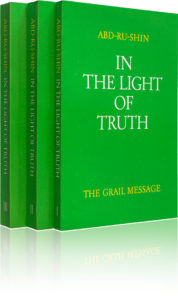
Abd-ru-shin writes in his work, In the Light of Truth, the Grail Message: “Thus out of agitation, mockery and harming your fellow-men there can never come any upbuilding whatever; for each kind of expression and attitude can only bring forth something similar, can only attract what is homogeneous! You must never forget this Law of Creation! It works automatically, and all human volition can never act against it! Never, do you hear that? Impress it upon yourselves, so that you may always heed it in your thinking, speaking and acting; for everything germinates from this and grows into your fate! Therefore never hope for anything else as fruit than always and only the same kind as the seed!”

The Laws and human destiny

The laws ground us in the reciprocal effects of our deeds. And rather than consider himself largely a creature of chance, an understanding of these laws would bring the knowledge that man is truly the master of his own destiny; since destiny is simply the sum of what he has woven for himself through the activity of the primordial laws. We would then cease to look for the cause in others, but would consciously make use of this knowl- edge and weave uplifting reciprocal experiences of fate or karma.

Let us consider a painful or unpleas- ant experience; it could be a disagree- able boss, an inconsiderate or even violent spouse, a false accusation, a terrible illness and so on. In most of these situations we are usually unable to see how we could have given room for our suffering and prefer to blame the cause on the faults or oversights of others, and in some cases we even venture to direct a quizzical glance upwards. Yet, the truth is that we ourselves give an opening to all that happens to us. Good will always bring forth good, joy more joy, and evil will never beget good, one can never plant corn and harvest rice, nor reap where one has not sown.

We may not remember how or when we sowed the seeds that we have to reap. And so it may seem that some people can get away with all sorts of injustice and those who make an effort to do things right can come unstuck. The problem arises in our inability to survey the whole cycle of sowing and reaping. Otherwise, a situation in which we feel ourselves as victim may then reveal to us that we actually brought things into being, including the many circumstances in which unintended consequences result from misplaced good intentions.

The cosmic laws are the channel of the Creator’s love to us. God’s Love is inseparably linked with Justice. There- fore sorrow or distress may not be punishment per se but an opening by which God’s love can reach us in a most beneficial manner. For is it not love when we are helped, be it through

pain, to come to an awareness of our faults and flaws, so that we may then strive in earnest to overcome them? Thus the laws bring the opportunities to learn and improve ourselves. When going through a painful experience, rather than complain, blame others or indulge in self-pity, one should strive to understand and ensure that one does not inflict the same on others. In this way, we not only cast off adverse karma, but we learn the lessons involved. Indeed, it is with this learning that the threads of fate can drop away from us.

For instance, in the case of the disagreeable boss, the question may well be: “Do you treat those under you with the kind of consideration you wish to receive?”

Is karma unchangeable?

We sow seeds of deeds every minute, every hour, every day. The experi- ences of today are the fruits of deeds from our past. And our attitude and reaction to the experiences we encounter again form seeds that contribute to tomorrow’s harvest.

Even if we cannot change the manifest present, with a consistent effort to live aright we begin to brighten our future. Though the fruits

of the wrong from yesterday do not suddenly vanish the minute we evidence goodwill, a consistent striv- ing towards the good deed is, in time, sure to bring about a change in our fate. Therefore, Abd-ru-shin in his work “In the Light of Truth” urges us:

“Make a start! But realise that all old debts must be settled. Do not expect blessings to rain down on you immediately, as many fools do. Perhaps some of you still have a long chain to expiate. But he who despairs on that account only harms himself, because it cannot be spared and remitted him.”

One does not need to look far to see what type of seeds we have sown in the main for a long time. The harvest is evident in the individual, in families and among nations – envy, conceit, hatred, distrust, violence, wars, corruption, disease ... all are fruits of a basic decision: the decision to be unfaithful to ourselves and to our duty, unfaithful in the most disastrous way to the Creator’s Will.

The way to effect change should then be clear. We all need to strive to

be faithful. An old fashioned expres- sion? Perhaps! But in reality it is the only way for us. For millennia, we have misused the laws to weave what is base, evil and ugly by our activities. The dark returns make life on earth unbearable as evil thrives everywhere.

What about forgiveness?

If we are bound to reap what we sow, where then does “forgiveness of sins” come in? Is it from proclaiming belief in the Creator and confessing our sins? “Whatsoever a man sows, that shall he reap.” This rings out so clearly. But is there any need for a person, who has a lot to make good, to panic on that account? Let us consider a man who lives a life of wickedness: he is ruthless in business and does not shy away from ‘eliminating’ anyone who stands in his way, those who work under him live in perpetual fear and his family regards him as a tyrant. His karma looms dark and foreboding around him ... and then an experi- ence, which touches him deeply, causes him to rethink his lifestyle. He begins to see how he oppresses those around him, and strives to be a better boss, father and husband. His partners in business are amazed at the change and so are all who knew him in his days of wickedness. In the working of the cosmic laws this change gradually uplifts him, his previously dark aura is lightened. Of course his past misdeeds remain connected to him through the threads of fate, but in no longer nourishing such threads their harvest of reciprocal action encounters an environment, which, as a result of the change in attitude, is no longer homogenous with the nature of the erstwhile deeds. The reciprocal effect is thus weakened in the manifestation, according to the degree to which the individual has changed for the good. Thus, an accident that may have claimed a life, claims a leg, or manifests as one hitting a toe against a stone. This is a symbolic redemption and is brought into effect by the power of the good volition. Abd-ru-shin writes:

“The power of good volition forms a circle around you capable of disin- tegrating the evil pressing upon you, or at least of greatly modifying it, exactly as the atmosphere also protects the earth.”

In adapting to the laws we not only set in train a brighter condition for ourselves but also develop a strong protection against oncoming dark currents, which either weaken consid- erably or only manifest symbolically.

How do we change our fate?

Let us recall that we activate the laws through our thoughts, words and actions and thereby weave our fate. The process is described in the Grail Message as follows:

“Every stirring of his spirit, every wavering of his soul, every action of his body, and every word he utters automatically and unconsciously ties ever new threads to the existing ones, attaching them, connecting one to the other, and interweaving them.”

We have lived with the misconcep- tion that thoughts are free, and thus in the belief that we are not account- able for them. But the truth is that we are held accountable; even stirrings that have not yet formed themselves into concrete thoughts activate the machinery of the cosmic laws. So we read also in the Grail Message that:

“The foundation for the upbuilding of a new humanity, which you cannot and must not evade, rests in the one sentence: Keep the hearth of your thoughts pure!

And it is with this that man must begin!”

Thoughts are powerful tools at our disposal with which we could bring about tremendous achievements. Each thought bears within it a certain magnetic quality that attracts similar thought forms and is thereby strengthened. A thought that we nurse and turn around in our mind gains in clarity and strength and expands in perspective. We often experience this but may not under- stand that it is the Law of Homogene- ity at work. This should make us cease trifling with thoughts and use them constructively. In using our thoughts consciously to improve conditions around us, in recognising the futility of harbouring thoughts of envy, hatred and bitterness, which will only bring us more of their kind, we will have succeeded in making faithful use of this medium of cosmic interaction. The Grail Message gives helpful hints in relation to using thoughts and cautions against a force- ful channeling of our thoughts to particular ends and instead encourag- ing a more natural transition by allowing the longing for that which is good to dwell constantly within us, such that it permeates every rising thought even before it takes form.

“Empty yourself of thoughts, and set free within you the urge for what is noble and good. Then you will have that foundation for thinking which comes from the volition of your spirit; and whatever arises from that you can then safely leave to the work of your intellect to carry out in the Realm of Densest Gross Matter. Nothing wrong can ever develop.”

“Let your communication be yea or nay; for whosoever is more cometh of evil.” is the admonition of the Son of God, Jesus Christ. Yet, spiteful, envious, destructive ... such is the nature of our words, and how often do we kill with them! Abd-ru-shin writes in the Grail Message: “Through ruinous, thoughtless and idle talk, all men have sown poison.”

With each word we utter we make use of a special gift of our Creator. And yet we chatter about the most unnecessary things, as silence increas- ingly appears to be a social ill, thereby breeding superficiality in conversa- tions. Again in the Grail Message:

“The words you form, the sentences, shape your outward fate on earth. They are like seed in a garden which you build around you; for each human word is part of the most vital thing that you can weave for yourselves in this Creation.”

With this we have yet another set of tools with which we can improve ourselves and our surroundings. Imagine that with our words we are able to make either blossoms or thistles grow around us in the form of pleasant or unpleasant experiences.

We are faithful when we act in such a way that the Laws weave only good threads for us. And we know when we act rightly or wrongly.

The call to faithfulness is an urgent one to a new way of life, a new culture, which in truth is the oldest. The virtue of faithfulness is by no means the preserve of woman alone, but through the special sensibility of her nature and her delicacy of intuitive perception, genuine womanhood is able to bring faithfulness to a much more refined expression than the man. The woman should be able, and indeed is required, to draw man’s gaze upwards to higher values. She forms the bridge of ennoblement for man through the nobility and gracefulness of her being and activity. It is the task of womanhood to keep alive the longing for nobility in humanity. And only if she is faithful can a woman achieve this. In no other way is it possible. Faithfulness is the lofti- est and most ideal virtue for all womanhood to strive towards!